Smithsonian Collections Blog

Highlighting the hidden treasures from over 2 million collections

Collections Search Center

Thursday, March 7, 2013

Sneak Peek from the Stacks: Tableau Vivant

Front Cover
As the Special Collections Cataloger for the Smithsonian Libraries, it seems I'm always coming across something wonderful or surprising in my cataloging backlog. While I spend my time creating and upgrading records for historically significant publications on science, technology, and the decorative arts to support research on artifacts in the Smithsonian's collections, they're not all serious scholarly works bound in leather with gilt-lettered spines.

Recently I was amused to find this adorable eight-page booklet, Baby's Letter, published by Raphael Tuck & Sons of London, Paris, and New York, dating probably from the 1890s. Beautifully designed, the booklet features chromolithographed illustrations and a cursive text in the form of a rebus, substituting pictures instead of spelling out some of the words, as a little child might do.


Example of the rebus-style text in Baby's Letter

Baby's Letter is written in the voice of a little girl vacationing at the seaside to her pet cat back home, together with the cat's response. Anonymously written and illustrated, the booklet ("no. 1027") was designed at Raphael Tuck & Sons' studios in England and printed at the Fine Art Works in Germany.


Back cover
This particular copy of Baby's Letter was given away as an advertising promotion. Inside the front cover, an ink-stamped notice reads, "These books given with AAAA Coffee and one pound can Unrivaled Baking Powder. Sprague, Warner & Company, Chicago." One of the largest wholesale grocery firms in the United States at the turn of the twentieth century, Sprague, Warner & Company offered a number of premium items like this booklet to help promote sales of its household goods. Inexpensive little publications like Baby's Letter, and similar printed advertisements and promotional items originally intended to be kept around for a short time before being discarded,  are known as ephemera

Ink-stamp on p. [2] of cover
Raphael Tuck & Sons, a British firm which flourished from 1866 until the 1950s, issued an astonishing variety and number of illustrated postcards, greeting cards, and other printed souvenirs that are highly popular collectibles today. Surviving examples of many items published by Raphael Tuck & Sons can be browsed online in the crowdsourced databases TuckDB and TuckDB Ephemera.


Baby's Letter. London ; Paris ; New York : Raphael Tuck & Sons, [189-?].
Call number: PZ7 .B339 1890z CHMRB Cooper Hewitt National Design Library

--Diane Shaw, Special Collections Cataloger, Smithsonian Libraries


Rills: Thrills, Spills and Chills


As the only Smithsonian Institution museum dedicated to local D.C. culture, The Anacostia Community Museum (ACM) has served as a center for community heritage and culture East of the River since its founding in1967. Over these past 45 years, the Anacostia Community Museum Archives (ACMA) has amassed a significant amount of audiovisual documentation of public programs and events, as well as community and personal histories from residents, on audiovisual media. Among those audiovisual holdings are an array of oral histories, including those that comprise the Anacostia Oral History Project of 1975. The project was created through the Center for Anacostia Studies and ACM and resulted in 72 original audiocassette recordings that document the lives of Anacostia residents in their own words with their own verbal nuances, making them a very unique type of historical record.


Among the many notable interviewees that participated in the Anacostia Oral History Project is Charles A. Williams, who shares stories of his life in Anacostia and working as a guard for various governmentalagencies during the 1940s and 50s. An interview with Thomas W. Turner provides personal documentation of his life as a student at Howard University and as an Anacostia resident during the 1880s and 90s. Husband and wife duo James and Marguerite Johnson discuss their childhoods in Anacostia during the 1930s and 40s. These three interviews alone provide oral history of life in Anacostia over the course of seven decades, pointing to the wide range of topics and events remembered through this oral history collection.


The original audiocassette recordings of all of the interviews conducted during the Anacostia Oral History Project are housed at ACMA and have been digitized for preservation and access purposes. Access copies can be listened to in the Archives Reading Room by making an appointment with the archivist: ACMarchives@si.edu


Taylor McBride
Audiovisual Archivist
Anacostia Community Museum

Test Post 5

How much do you know about the stone figures, called moai, on this tiny Polynesian island? Easter Island, known to residents as Rapa Nui, has long puzzled those who encounter the enormous statues. Although there is no one left to tell us for sure, experts speculate that the moai were constructed around 1200 CE by the original Polynesian settlers as representations of their clans’ revered ancestors.

Man Near Moai (Lava Stone Effigy Figures) at Base of Outer Slope of Volcano 1890, NAA 04960500
Man Near Moai (Lava Stone Effigy Figures)
at Base of Outer Slope of Volcano 1890,
NAA 04960500
This society’s belief system centered on the concept of mana, a magical or spiritual essence. Oral legend says that this is the power that was able to move and erect the moai. The figures, once placed atop their platforms (ahu), were believed to watch over their clan’s territory and protect it with the power of mana. The figures did not have mana until they were given eyes (made of white coral and obsidian or red scoria), however.  There are no remaining moai with their original eyes intact, but several have been restored for demonstration purposes. With or without eyes, these statues still appear majestic and stoic.

The National Anthropological Archives holds a variety of photographs and drawings of these massive stone figures.

The Smithsonian Institution is also in possession of two moai, one of which is on display in the National Museum of Natural History. These two specimens (Head SI-WDC-002 and Moai SI-WDC-001) came from an inland site called Ahu O’Pepe and were brought to the Smithsonian in 1887. William J. Thomson of the U.S. Navy collected the statues on behalf of the Smithsonian Institution in December 1886 and transported them to Washington, D.C. on the U.S.S. Mohican.


George Brown Goode, Samuel D. Langley, and Otis T. Mason with Two Moai (Lava Stone Effigy Figures) Inside Museum Building n.d., NAA 04960200
George Brown Goode, Samuel D. Langley, and
Otis T. Mason with Two Moai (Lava Stone Effigy 
Figures) Inside Museum Building n.d.,
NAA 04960200
Until fairly recently, many people were unaware that there are bodies underneath those huge stone heads! Due to the age and shifting landscape of the island, some of the figures have been buried up to their shoulders, making it appear as though they were simply heads. The moai currently displayed in the NMNH (on the left in the above photo) is fully intact, and if you look closely you can see the detail of the hands and fingers laid across the stomach. The moai in the two other photos, taken on Easter Island, are examples of partially buried figures. We can only see the heads and shoulders here, but fully excavated they would appear even taller! The Easter Island Statue Project has been working since 1982 to catalog, excavate, and preserve moai, and they have lots of interesting related information on their website.

You can find other Smithsonian collections related to Easter Island here.

— Jocelyn Baltz, Intern, National Anthropological Archives

Test Post 4

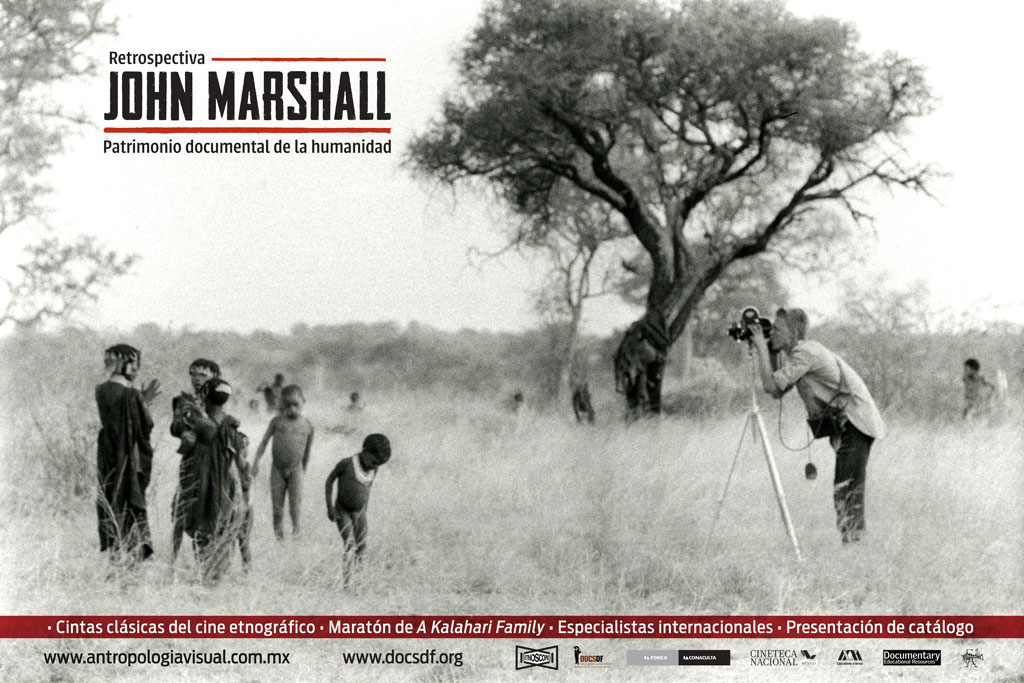
Postcard for Cine en Culturas retrospective of
John Marshall's work, held Nov 10-14, 2012 in Mexico City.
From November 10-14, 2012, audiences in Mexico City were treated to an extensive retrospective of the ethnographic and documentary films of John Marshall. Marshall is best known for his life-long involvement with the Ju/'hoansi, a group of !Kung Bushmen who live in the Kalahari Desert in northeastern Namibia. This retrospective covered both major films and lesser-known works about the Ju/'hoansi, and also explored Marshall's work in the United States, including a documentary series on police work in Pittsburgh, PA.

The retrospective was hosted by Cine en Culturas, an annual program produced by Ethnoscopio as part of the DocsDF documentary film festival. The program was put together with the collaboration of the Human Studies Film Archives (archival home of Marshall's Ju/'hoan Bushman collection) and Documentary Educational Resources (distributor of Marshall's films).


Trailer for the John Marshall retrospective edited by Cine en Culturas.

The incredible team behind Cine en Culturas brought Marshall's work to a Spanish-speaking audience for the first time. Their efforts resulted in Spanish-subtitled versions of all the films shown, including the six-hour series, A Kalahari Family, as well as a fine catalog with a mix of new and previously published essays on Marshall's work, all carefully translated into Spanish. The catalog presents important reflection and scholarship on Marshall's films that was previously only available in English, including an article by our own Jake Homiak, Director of Anthropology Collections and Archives Program at the National Museum of Natural History.

Ticket holders line up at the Cineteca Nacional in Mexico City
for a screening of John Marshall's N!ai, The Story of a !Kung Woman.
© Francisco Palma Lagunas
I was lucky enough to attend the retrospective as an invited guest and speaker. What a gift it was to spend a week immersed in Marshall's films and engaged in discussions about his work and his legacy. Mexico City filmgoers provided the best gift of all - sold-out screenings almost every night of the retrospective, held primarily at the beautiful, newly-renovated Cineteca Nacional. A Kalahari Family (2002) was screened in its entirety throughout one afternoon and evening in a smaller, more intimate theater in the city's energetic downtown. Not only did this six-hour marathon sell out, but many audience members stayed long after for a passionate discussion about the series' implications and lessons for the present.

John Marshall is well-regarded as a major figure in ethnographic film. His work has been the subject of PhD theses and academic articles, and scores of undergraduate students have seen his seminal film, The Hunters (1958), in Anthropology 101 classes. His archival film and video collection is recognized as an important piece of our global documentary heritage and is listed on UNESCO's Memory of the World register. This is all impressive, but it doesn't tell us about the actual impact archival films might have on an individual.

My experience at Cine en Culturas showed me what that impact can be. Each night, anthropologists, filmmakers, students, and cinephiles filled the theater to learn about a time, a culture, a way of life very different from their own. Each night, that audience stayed long after the screening for Q&A sessions and discussions that covered a wide range of topics:  John Marshall's working style and deep commitment to the Ju/'hoansi; the evolution of documentary filmmaking techniques; the ethics of documentary and ethnographic filmmaking; the successes and failures of international development work; the current political and economic standing of the Ju/'hoansi; the struggles of indigenous groups in Mexico and worldwide.

N!ai, The Story of a !Kung Woman screens at the Cineteca Nacional.
© Francisco Palma Lagunas
Having worked for John Marshall on his last project, the reception his films received in Mexico City was deeply gratifying on a personal level. It was equally wonderful from a professional perspective, reinforcing the value of the work that the Human Studies Film Archives has undertaken to preserve Marshall's large audiovisual collection and make it accessible for research and exhibition.

Karma Foley, Smithsonian Channel
(and former contract audiovisual archivist at Human Studies Film Archives)

I am grateful to Francisco Palma Lagunas for his beautiful photographs of the Marshall retrospective, and his permission to use them in this post.


Test Post 3

President Nixon’s 1973 Inaugural ball at the Museum
of History and Technology, January 20, 1973,
by Richard K. Hofmeister, Smithsonian Institution
Archives, Record Unit 285, Box 10,
Folder: 11, 73-518-14A or SIA73-518-14A.
This weekend DC plays host to the presidential inauguration. As visitors flock to the area, the Smithsonian will open its doors to museum goers and inaugural ball guests alike. The buildings are no stranger to inaugural events. As early as 1881, the Smithsonian’s  National Museum (now the Arts and Industries Building) hosted its first Inaugural Ball for President James Garfield, even before the building was completed.  The museums provide a fascinating backdrop for such festivities, and Garfield’s ball began a trend that has continued to this day.

One particularly memorable experience occurred on January 20, 1973, as President Richard Nixon attended several official inaugural balls, including one at the Smithsonian’s Museum of History and Technology (now the National Museum of American History). Over seven thousand people, dressed in fine feather, filled the museum to celebrate. Lines were out the door, and the crowds had nowhere to dance. Despite the confusion and heat the room had a celebratory air and guests were excited to see the man of the hour.

Chicken that disrupted President Nixon’s 1973 Inaugural ball,
January 20, 1973, by Unknown, Smithsonian Institution Archives,
Record Unit 285, Box 10, Folder 12, SIA2009-0415 and 73-688-22A.
It seems, however, that people were not the only spectators anxious to catch a glimpse of the President. While guests danced the night away, a female participant became quite ruffled when a chicken flew into her one thousand dollar VIP box and began to assault her. Fortunately, then Smithsonian Secretary S. Dillon Ripley, an ornithologist, came to the disgruntled socialite’s rescue. He captured the bird and began to smooth the chicken’s feathers until it calmed down. He then returned the culprit to its home in the colonial barnyard exhibit of the Growth of the United States Hall.

The chicken, along with a few other fellow fowls, took up residence in the museum in 1969 to give a sense of realism to the American farm life exhibit.  The birds lived in the exhibit and according to museum staff, were usually quite docile. However, this little chicken must have had political ambitions and decided crossing the exhibit road to participate in the inaugural ball would be a fun adventure. Secretary Ripley remarked that the incident was “a real chicken caper” that certainly added to the excitement of the night.  Once again, a visit to the Smithsonian, whether a school trip or an inaugural ball, proved to be a unique adventure. 

Courtney Bellizzi, Smithsonian Institution Archives

Test Post 2


(NAA 76-55:6) Crown of Lincoln Cane belonging to Zuni Pueblo, 1975.
Photo Lot 76-55, National Anthropological Archives, Smithsonian Institution.
With the success of Steven Spielberg’s film, Lincoln, and its recent nomination for 12 Academy Awards, Abraham Lincoln-themed blog posts are all the rage, and who are we to go against grain?  At the National Anthropological Archives (NAA), our records show that Abe’s cane seems to have made the rounds in the 150 years following his administration.  A “Lincoln Cane” appears in several photos in our collection with the earliest from 1877 and the most recent from 1975.  A closer look reveals that the cane in these pictures is actually multiple canes, and though they never actually belonged to the president, their history is still very interesting.
 

That history begins in the 16th century when Spanish explorers came in contact with the pueblo civilizations in what is now the Southwest United States.  As detailed by Martha LaCroix Dailey in the New Mexico Historical Review, the Spanish, though assuming overall control of the territory, recognized the pueblos as “semi-autonomous municipalities with certain inherent rights of self-government.”  In addition to their own leaders, the pueblos began electing or appointing officers to act as liaisons between them and the Spanish government.  These officers then “received a black cane trimmed with silver and silk tassels as a symbol of authority.”
(NAA 06342700) Portrait of Antonio Al
Churleta (Tse-wa-àn-ye), Governor of San
Juan Pueblo, holding a Lincoln Cane, circa
1877. BAE GN 2031, National Anthropological
Archives, Smithsonian Institution.

When Mexico won its independence from Spain in 1821, the new government acknowledged the land grants and authority given to the pueblos by the Spanish, “and in some cases, the Mexicans issued new canes to some of the pueblos.”  As was the case with Spain, the Mexican government did not always or was not always able to ensure the pueblos remained free from injustice or the encroachment of settlers.  But the pueblos at least received formal recognition from these governments.

When the United States took control of Southwest territories following the Mexican War, it agreed to honor the Spanish land grants.  However, the Office of the State Historian of New Mexico notes that the presidents of that era did not recognize the pueblos’ sovereignty, and the years between the Mexican and Civil wars saw the suspension of the cane tradition. 


(NAA 06366500) Portrait of Mariano
Carpintero, Governor of Sandia Pueblo,
holding a Lincoln Cane, 1899.
Photograph by De Lancey Gill. BAE
GN 2079A, National Anthropological
Archives, Smithsonian Institution.
( NAA 06348800 ) Portrait of Jesus
Antonio Moya, Governor of Santa
Ana Pueblo, holding a Lincoln Cane,
1899. Photograph by De Lancey Gill.
BAE GN 2208A, National Anthropological
Archives, Smithsonian Institution.
This lasted until 1863 when Dr. Michael Steck was appointed Superintendent of Indians for the Territory of New Mexico.  The pueblo tribes of that territory filed petitions for U.S. Land Patents with Steck to get the U.S. to honor its treaty agreements.  Steck saw to it that the patents were granted, and, having learned of the cane tradition through research, ordered 19 ebony canes with “A. Lincoln” and the tribe’s name engraved on their silver crowns.  He presented the patents and the canes to the pueblo governors, and the tradition was reborn in the “Lincoln canes” as they came to be called.

More canes were ordered and presented as other pueblo tribes received their patents, and Dailey notes the canes became a “significant material possession of the Pueblo Indians of New Mexico.”  A Lincoln cane is now a “symbol of the office of governor” who will “perform a service to his people for his term of office,” head “the secular affairs of the pueblo,” and also act “as liaison to outsiders.”

The significance of the Lincoln canes is evident in the photos on this page, which depict pueblo governors holding their canes.  The cane in the top picture, which belongs to the Zuni pueblo, had an anecdote in Dailey’s article.  At one point the tribe lost its cane and requested a new one from the Bureau of Indian Affairs.  Dailey notes that “uneasiness characterized the pueblo and a serious search took place.”  The original was eventually found and the replacement was returned.

This Zuni Lincoln cane photo is part of Photo Lot 76-55 at NAA and is one of several photos involving the cane from 1975 which testifies to the enduring importance of the Lincoln cane.  You can learn more about Lincoln canes at New Mexico Office of the State Historian’s Web site.

— Adam Minakowski, Reference Archivist, National Anthropological Archives
 

Test Post


                                                                           Nope!

NMAI Archive Center Stacks
Archives around the world document human history.  They hold materials fundamental for academic and personal research on almost every subject conceivable and have long been collecting immeasurable amounts of material long before the birth of the internet.  The Smithsonian Institution, for example, was founded in 1846 with a dedication to the “increase and diffusion of knowledge”.  The Smithsonian’s first website was inaugurated in 1995.  That leaves 149 years of collected knowledge before we even had an online presence. 

In addition to working at the National Museum of the American Indian Archives Center, I am also in graduate school.  I am often frustrated with the assumption by students that research can be done solely through the use of the internet.  The internet is a useful tool, however, it is inconceivable that over 149 years of material could be fully digitized in the 18 years since we've had the internet, let alone high-quality equipment.  Can you imagine loading a digital archive on Netscape?

A portion of the Museum of the American
 Indian, Heye Foundation Records


Never fear!  Archivists around the Institution are working tirelessly to fulfill the Smithsonian’s mission of “diffusion of knowledge” and bringing you complete and accurate digitized material.  The project that I am involved with is the digitization of the Museum of the American Indian, Heye Foundation records. Over the past two years we have digitized 51 boxes of manuscript material, that is, more than 50,000 pages!  

Digitizing archival material is a bit more complicated than running documents through a scanner as we have unique and original material.  A few examples:


Fragile Materials: Manuscripts like this field notebook from 1896 require special care, handling, and more time when imaging.


Culturally Sensitive Materials: This is defined in different ways by members of individual tribes, ethnic groups, nations, communities,and religious denominations, but usually include materials that relate to traditional knowledge and practices.  Such materials may not be digitized.


Oversize Materials: The physical size of certain items also require additional digitizing techniques.

So, what is available online?  While large collections may not be fully digitized, we have a lot of digital resources available to help the researcher in their quest.  These online finding aids serve as a guide to the collections and provide a detailed description of the contents and arrangement of an archival collection.  After that, once a researcher gets familiar with our collections, they may make an appointment to come see us and conduct their research!

Remember, Archivists and Librarians are here to help you.   If you don’t live in the DC area, ask your local reference librarian for a place to start. As you are considering avenues of research, don’t limit yourself to what is available online, or you may be missing out on a world of knowledge.

Nichole Procopenko
Archives Scanning Technician